TRAVEL

Thursday, December 9, 2021

Friday, December 3, 2021
Where the housing market is going in 2022 as told by 7 leading forecast models
A perfect storm. That's the best way to describe the red-hot housing market we've seen from coast-to-coast during the pandemic. It was spurred by a combination of recession-induced low mortgage rates, remote work allowing buyers to sprawl further away from their workplace, and a demographic wave of first-time millennial homebuyers entering into the market. Of course, years of under-building means there simply aren't enough homes available to meet this demand. Cue record price growth.

But how much longer will this run last? After all, home price appreciation of 19.9%—a 12-month record set between Aug. 2020 and Aug. 2021—can't be sustained forever.
Already, there are signs the housing boom is losing some steam. We're seeing seasonality—a cooling period that happens like clockwork most years—return to the market after it was absent during the holiday and vacation stretch last year. That's not all: More homebuyers are finally beginning to push back against surging prices. Indeed, in October 60.3% of sales involved a bidding war, which is down from the all-time high in April (74.5%). There's also the increased likelihood the Federal Reserve will raise rates to tamp down inflation. Rising mortgage rates would price out some buyers altogether.
What does this mean for home price growth in 2022? To find out, Fortune reviewed seven industry forecast models. But buyers and sellers alike won't get much peace of mind from these forecasts: The economic models don't produce anything close to a consensus. Some of these forecast models predict price growth next year will go down as one of the highest on record. Others are forecasting a rate of appreciation that would be the slowest in more than a decade.
Let's take a look at these models—and also look at why there's so much uncertainty heading into next year.
On the high end of the spectrum are Zillow and Goldman Sachs. Zillow projects home prices will rise 13.6% between Oct. 2021 and Oct. 2022. Meanwhile, Goldman Sachs forecasts a 16% uptick between Oct. 2021 and Dec. 2022 (or 13.5% on an annualized basis). For perspective, the largest 12-month uptick in the lead up to the 2008 housing crash was 14.1%. Simply put: Researchers at both Zillow and Goldman Sachs see priced out buyers falling further behind next year.
“The supply-demand picture that has been the basis for our call for a multiyear boom in home prices remains intact...Of all the shortages afflicting the U.S. economy, the housing shortage might last the longest," wrote Goldman Sachs in its 2022 outlook.
What's going on? Well, neither Zillow nor Goldman Sachs foresees the demographic wave of first-time millennial homebuyers letting up. We’re in the midst of the five-year period (between 2019 and 2023) in which the five largest millennial birth years (between 1989 and 1993) are hitting the all-important first-time home buying age of 30. According to their forecasts, there won't be enough homes to satisfy all of that demand next year.
Since 1980, Fortune calculates home prices on average have climbed 4.6% per year. Over the past year, price growth (19.9%) is four times that level.
The good news for would-be home buyers? Among the seven forecast models Fortune examined, four predict we'll see price growth in 2022 fall back closer to the historical average. That includes Fannie Mae and Freddie Mac, which are predicting U.S. home price growth of 7.9% and 7%. That's slightly higher than the historical norm, however, it's hardly the eye-popping numbers we've seen during the pandemic. Meanwhile, models released by Redfin and CoreLogic foresee 12-month price growth falling to 3% and 1.9%, respectively.
What do the models predicting substantial price deceleration have in common? They foresee price growth getting chopped down by rising mortgage rates. As of Monday, the average 30-year fixed mortgage rate stands at just 3.1%. By the end of 2022, Fannie Mae projects it'll hit 3.4% while Redfin's model says 3.6%. Those jumps are bigger than they might appear at first glance. Let's say a borrower took on a $500,000 mortgage. At a 3.1% mortgage rate, they'd see a $2,135 monthly payment (not factoring in any taxes or insurance). But if that rate were the 3.6% as projected by Redfin, that payment would rise to $2,273—or nearly an additional $50,000 over the course of the 30-year mortgage.
Another unknown: Will corporate America begin pushing harder next year to bring staffers back into the office? If the workplace is less WFH friendly next year, that could translate into fewer buyers in both second home markets (like the Hamptons) and in the exurbs. That concern is shared by Frank Martell, CEO of CoreLogic, who wrote in the real estate data firm's latest forecast that "as we head into 2022, we expect some moderation in the current pattern of flight away from urban cores as the pandemic wanes.”
But there is one outlook that is relatively bearish on price growth.
The Mortgage Bankers Association, an industry trade group, is predicting that the median price of existing homes will decrease by 2.5% between the fourth quarter of 2021 and the fourth quarter of 2022. When you look closely at its model, it's easy to see why: The Mortgage Bankers Association is forecasting that the average 30-year fixed mortgage rate will hit 4% by the end of 2022. Over the course of 30 years, that'd add an additional $90,000 in cost to a $500,000 fixed rate mortgage
That said, even if the Mortgage Bankers Association's price drop comes to fruition, it'd hardly be a housing crash. In fact, in that scenario, U.S. home prices would still be up over 20% from pre-pandemic levels.
Thursday, December 2, 2021
GEOPOLITICS OF FRANCE: WILL MACRON MAKE EUROPE A SUPER POWER
The 21st century brings great changes for the world order. The French recognize these and want Europe to keep up with the US and China. Will France lead Europe towards a superpower? Welcome to the next episode of The 20s Report.
How President Macron plans to capture Africa's demographic wave by using the French language, with the ultimate goal to cement French hegemony worldwide. BAKU - For centuries, France was a global powerhouse, permeating its will over five continents. Since those imperial days, it has lost considerable ground in its former domains. Only in Africa did France retain its hold, owing to the monetary system that was put in place. In the decade after World War II, President François Mitterand was quoted saying: “Without Africa, France will have no history in the 21st century.” Like a foretelling coming true, it is precisely because of Africa that modern-day France is returning as the global force it once was. And it’s using the soft power attributes of language to cement its hegemony
Can Macron lead the European Union after Merkel retires?
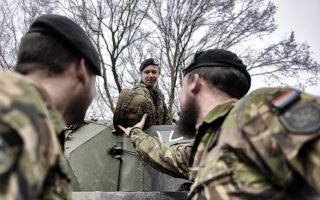
Troops from a European tank battalion that consists of Dutch and German soldiers prepare for an exercise near Oldenburg in northern Germany on Feb. 4, 2019.
After Germans vote Sunday and a new government is formed, Chancellor Angela Merkel will leave office after 16 years as the dominant figure in European politics. It is the moment that French President Emmanuel Macron has been waiting for.
The German chancellor, although credited for navigating multiple crises, was long criticized for lacking strategic vision. Macron, whose more swaggering style has sometimes ruffled his European partners — and Washington — has put forward ideas for a more independent and integrated Europe, better able to act in its own defense and its own interests.
But as the Anglo-American “betrayal” in the Australian submarine affair has underscored, Macron sometimes possesses ambitions beyond his reach. Despite the vacuum Merkel leaves, a Macron era is unlikely to be born.
Instead, analysts say, the European Union is heading for a period of prolonged uncertainty and potential weakness, if not necessarily drift. No one figure — not even Macron or a new German chancellor — will be as influential as Merkel was at her strongest: an authoritative, well-briefed leader who quietly managed compromise and built consensus among a long list of louder and more ideological colleagues.
That raises the prospect of paralysis or of Europe muddling through its challenges — on what to do about an increasingly indifferent America, on China and Russia, and on trade and technology — or even of a more dangerous fracturing of the bloc’s always tentative unity.
And it will mean that Macron, who is up for reelection in April and absorbed in that uncertain campaign, will need to wait for a German government that may not be in place until January or longer, and then work closely with a weaker German chancellor.
“We’ll have a weak German chancellor on top of a larger, less unified coalition,” said Mujtaba Rahman, managing director for Europe of the Eurasia Group, a political risk consultancy. “A weaker chancellor is less capable of exerting influence in Europe, and then with the Macron election, the political cycles of these two key countries will not be in sync.”
The uncertainty is likely to last until after the French parliamentary elections in June — and that is presuming Macron wins.
Macron has argued forcefully that Europe must do more to protect its own interests in a world where China is rising and the United States is focusing on Asia. His officials are already trying to prepare the ground on some key issues, looking forward to January, when France takes over the rotating EU presidency. But given the likelihood of lengthy coalition talks in Germany, the window for accomplishment is narrow.
Macron will need German help. While France and Germany together can no longer run the European Union by themselves, when they agree, they tend to bring the rest of the bloc along with them.
So building a relationship with the new German chancellor, even a weaker one, will be a primary goal for Macron. He must be careful, noted Daniela Schwarzer, executive director for Europe and Eurasia of the Open Societies Foundations, not to scare off the Germans.
“Macron’s leadership is disruptive, and the German style is to change institutions incrementally,” she said. “Both sides will need to think through how they make it possible for the other side to answer constructively.”
French officials understand that substantive change will be slow, and they will want to build on initiatives already underway, like the analysis of Europe’s interests called “the strategic compass” and a modest but steady increase in military spending on new capabilities through the new European Defense Fund and a program called Pesco, intended to promote joint projects and European interoperability.
After the humiliation of the scuttled submarine deal, when Australia suddenly canceled a contract with France and chose a deal with Britain and the United States instead, many of his European colleagues are more likely now to agree with Macron that Europe must be less dependent on Washington and spend at least a little more in its own defense.
Few in Europe, though, want to permanently damage ties with the Americans and NATO.
“Italy wants a stronger Europe, OK, but in NATO — we’re not on the French page on that,” said Marta Dassu, a former Italian deputy foreign minister and director of European affairs at the Aspen Institute.
Italian Prime Minister Mario Draghi, whose voice is respected in Brussels, believes strongly in the trans-Atlantic relationship, Dassu said, adding, “We’re closer to Germany than to France, but without all the ambiguities on Russia and China.”
France also wants to become more assertive using the economic and financial tools Europe already has, especially trade and technology, the officials say. The point, they say, is not to push too hard too fast, but to raise the European game vis-à-vis China and the United States, and try to encourage a culture that is comfortable with power.
But France’s German partners will be going through a period of uncertainty and transition. A new German chancellor is expected to win only one-quarter of the vote and may need to negotiate a coalition agreement among three political parties. That is expected to take at least until Christmas, if not longer.
The new chancellor will also need to get up to speed on European issues, which barely surfaced in the campaign, and build credibility as the newcomer among 26 other leaders.
“So it’s important now to start thinking of concrete French-German wins during a French presidency that Macron can use in a positive way in his campaign,” Schwarzer said. “Because Berlin does not want to ponder a scenario in which Macron loses” to far-right Marine Le Pen or in which euroskeptics like Matteo Salvini take over in Italy.
Whoever wins, German policy toward Europe will remain roughly the same from a country deeply committed to EU ideals, cautious and wanting to preserve stability and unity. The real question is whether any European leader can be the cohesive force Merkel was — and if not, what it will mean for the continent’s future.
“Merkel herself was important in keeping the EU together,” said Ulrich Speck of the German Marshall Fund. “She kept in mind the interests of so many in Europe, especially Central Europe but also Italy, so that everyone could be kept on board.”
Merkel saw the European Union as the core of her policy, said a senior European official, who called her the guardian of true EU values, willing to bend to keep the bloc together, as evidenced by her support for collective debt, previously a German red line, to fund the coronavirus recovery fund.
“Merkel acted as mediator when there have been a lot of centrifugal forces weakening Europe,” said Thomas Kleine-Brockhoff, head of the Berlin office of the German Marshall Fund. “It’s less clear how the next chancellor will position himself or herself and Germany.”
Still, Mark Leonard, director of the European Council on Foreign Relations, noted that “whoever is the chancellor, Germany is still responsible for more than half of Chinese trade with Europe.” Germany is “vastly more important than the other countries on all the big issues, from how to handle China to the tech wars and climate change,” he said.
That means Macron “knows he has to channel German power behind his vision,” he said.
But French and Italian positions will be crucial, too, on important pending financial issues like fiscal and banking integration, trying to complete the single market and monitoring the pandemic recovery fund.
Merkel’s departure may provide an opportunity for the kinds of change Macron desires, even if in vastly scaled-down version. Merkel’s love of the status quo, some analysts argue, was anachronistic at a time when Europe faces so many challenges.
Perhaps most important is the looming debate about whether to alter Europe’s spending rules, which in practical terms means getting agreement from countries to spend more on everything, from defense to climate.
The real problem is that fundamental change would require a treaty change, said Guntram Wolff, director of Bruegel, a Brussels research institution. “You can’t have fiscal and defense integration by stealth,” he said. “It won’t have legitimacy and won’t be accepted by citizens.”
But the German election debates ignored these broad issues, he said.
“The sad news,” Wolff said, “is that none of the three chancellor candidates campaigned on any of this, so my baseline expectation is continued muddling forward.”
Who will lead Europe after Merkel? Presidents and prime ministers jockey for the job.
As Germany prepares to elect its next chancellor Sunday, Europe is readying itself for a major shake-up of the unofficial hierarchy of continental leaders.
In nearly 16 years at the helm of Europe’s largest economy, Angela Merkel became the de facto representative on the world stage and the European Union’s chief power broker through countless late-night negotiations and a string of crises.
Germany will continue to wield immense influence. However, Merkel’s experience and reputation give her clout that none of her potential successors as chancellor could hope to match anytime soon. And so her departure will create an opening — for the first time in more than a decade — for other leaders to assert themselves and their vision for Europe.
A few favorites have emerged in the competition. French President Emmanuel Macron, head of the European Union’s second-biggest economy, has been jockeying for years to be the next leader of Europe. Italian Prime Minister Mario Draghi, best known for saving the euro while president of the European Central Bank, also has several of the necessary credentials.
But analysts, politicians and diplomats tend to agree that no one person is capable of filling Merkel’s loafers. Instead, they say, it will probably involve a coterie of premiers — probably all of them men.
“Merkel’s exit creates a problem with leadership, a hole at the heart of Europe,” said Giovanni Orsina, director of Luiss Guido Carli University’s School of Government in Rome. “Either the new chancellor fills that void, or we need to conceive of a collective convergence.”
After 16 years, Germany’s Merkel is stepping down. Here’s how she built her legacy.
There will be a marked shift in the balance of power, said a senior E.U. diplomat, and other European leaders will have to step up.
“This cannot only be done by one. It has to be done by the group,” he said, speaking on the condition of anonymity to discuss the sensitive political situation.
Merkel isn’t expected to leave office immediately after the election. The results are likely to be messy, and coalition talks could go through the end of the year — or beyond. Merkel would stay on as a caretaker until a new government is formed.
And then? Whoever steps into the job — the candidates include Armin Laschet, Olaf Scholz and Annalena Baerbock — would need time to settle in, and to establish themselves, before they could expect to command the sort of attention that Merkel has in Europe and internationally.
“Any German chancellor will move into a powerful position,” said Daniela Schwarzer, executive director for Europe and Eurasia at the Open Society Foundations. “Any next German chancellor will bring some experience and bring the same weight of the country to the table, but the personal weight will not be the same.”
What you need to know about Germany’s election
If Britain were still in the European Union, some of the power might shift across the English Channel. But in a post-Brexit world, London cannot expect to speak on behalf of the continent.
So, many heads are turning toward Paris.
“The German elections are being seen in France as an opportunity for a reset, where whoever comes in will have less stature than Macron does and whereby France’s influence in Europe would be increased,” said Nicholas Dungan, a senior fellow at the Atlantic Council.
Macron has been preparing for this moment. He has repeatedly sought to emphasize his foreign policy experience, drawing a contrast with the German chancellor candidates, who spent most of their televised debates bickering about domestic politics.
Macron also has spent years outlining his vision for Europe.
In 2017, after another German election, he delivered a sweeping speech at Sorbonne University, arguing that the best response to ascendant nationalists was to acknowledge the European Union’s shortcomings — it is “too weak, too slow, too inefficient” — and then to work to make it stronger and more united.
He has reprised the theme many times. But his proposals — to integrate European defense, reform the euro zone, develop a common asylum policy and impose a new tax on U.S. tech giants — have not been enthusiastically embraced.
French ambassador to return to Washington as Biden, Macron seek to mend rift
The French president has lately been using the chaotic Afghanistan withdrawal, and a fight with the Biden administration over a nuclear submarine deal, to reiterate a call for European “strategic independence.” Other E.U. leaders have said they stand with France in the submarine spat, and they are equally frustrated about Afghanistan. Still, the idea of an E.U. military is far from becoming a reality.
Macron’s mandate as Europe-wide leader may depend in part on how much progress he makes when France takes over the Council of the European Union’s rotating six-month presidency in January — as well as on his showing in France’s presidential election in April. His main competitor, far-right leader Marine Le Pen, has a radically different view of the European project.
“To the question who will take the mantle, you already know the answer: It will be Macron,” an E.U. diplomat said, speaking on the condition of anonymity to offer a candid assessment. “The next question is: Will he retain the mantle?”
The determining factor, the diplomat said, may be whether Macron can learn to compromise.
“Macron has the tools and the chance to, for now, fill that void,” the diplomat said. “But he will only stay there in that position if he manages to bridge the gap between him and his way of doing things, and the east and the north and everybody else. That was Merkel’s way.”
Does the European Union need its own army? Afghanistan withdrawal revives an old debate.
Merkel’s critics, however, sometimes hold that against her. They say she delayed decisions at the E.U. level in an effort to preserve consensus and avoid conflict — and while doing so allowed for the erosion of democratic norms in countries such as Hungary and Poland. Her approach even earned its own verb: “Merkeln,” meaning to dither or bide one’s time.
“During the Merkel era, one always tried to handle and solve things among the 27, often postponing until the very last minute the required solutions for Europe, because of Merkel’s conviction that results could only be yielded by standing together,” said Sandro Gozi, a veteran Italian politician who now represents France in the European Parliament as part of Macron’s centrist “Renaissance” list.
“I believe Macron and Draghi can make all the difference here,” Gozi said.
The French president and Italian prime minister were dubbed Europe’s “new power couple” by Politico in July, amid reports of a transalpine bromance. The two men, separated in age by 30 years, are both former investment bankers and longtime E.U. boosters, and have similar goals for the 27-nation bloc, especially on fiscal policies, where both favor further financial integration.
“I believe that in this new phase, leadership could be collective,” Gozi said. “I see Macron and Draghi as protagonists of that.”
At first, their leadership of Europe would be “two-legged,” Gozi said, but it would eventually include the new German chancellor. Indeed, many observers expect Macron would need strong German partnership to execute the most ambitious of his plans. But Gozi said the result would be “less Merkel-ian” — with faster action and less caution.
Germany’s Merkel makes final campaign push for stumbling political heir
Draghi has been positioning himself to take on a greater leadership role, observers say. He was a prominent voice in Europe’s reaction to the Afghanistan withdrawal, pushing for an emergency summit of the G-20, criticizing the European Union’s disorganized stance on accepting refugees, and calling President Biden during the evacuation efforts. In March, Draghi made headlines when he blocked the export of a batch of AstraZeneca coronavirus vaccine doses from the European Union amid a shortage inside the bloc. And he has been talking of using nearly $235 billion in E.U. money to enact an “epochal” pandemic recovery.
But his own sway may be limited by the size and influence of his country.
“The problem across history is not only who you are but the kind of car you’re driving,” said Orsina, of Luiss Guido Carli University. “Some things you can only do if you’re Germany, otherwise it’s that much harder, regardless of the leader’s personality.”
A number of other leaders will be elbowing for a more important role, including Spanish Prime Minister Pedro Sánchez and Dutch Prime Minister Mark Rutte. Both share one obvious trait with their counterparts in France and Italy: They’re men.
After Merkel’s departure, council summits risk taking on the feel of an old boys’ club, said Open Society’s Schwarzer.
“There’s a certain element of having a female leader at the table — the balance will shift in that regard, as well, and that does make a difference in group dynamics,” she said. “Not only what happens in the room but the reception of politics.”
Some Europeans are sure to welcome Merkel’s egress as a chance for potential realignment and more substantive reforms to the European Union.
The Merkel era “has led to a Europe that is highly dependent on Germany and Germany’s choices,” said Rosa Balfour, the director of Carnegie Europe. “The gravity of power has shifted to Berlin, and it hasn’t been all for the good of the rest of Europe. If there’s a slight change in the balance of power, tipped in the favor of a broader pioneering group, from a European perspective there could be benefit in that.”
Critics argue, for instance, that Germany’s response to the euro-zone debt crisis and its push for austerity measures did deep and lasting damage to Greece and Italy, Balfour said.
Still, Merkel’s support remains strong across the continent — yet another indicator of how difficult she will be to replace. A recent survey by the European Council on Foreign Relations asked residents in 12 E.U. nations who they would vote for in a hypothetical election for president of Europe, Merkel or Macron.
Wednesday, December 1, 2021
GEOPOLITICS OF ROMANIA
US army tanks and soldiers continued being deployed on Tuesday to an air base in southern Romania, after the first shipment of tanks had arrived the day before. The tanks were offloaded from a train in the village of Mihail Kogalniceanu, where they would be taken to a nearby military air base. The deployment, known as Operation Atlantic Resolve, is part of an American operation to reassure NATO allies and other partners concerned about Russia. Five hundred US soldiers will eventually be deployed at the Mihail Kogalniceanu Air Base in Constanta County. The operation foresees the continuous presence of an American armoured brigade combat team in Europe on a nine-month rotational basis.
US to Turn Romanian Airbase into NATO Black Sea Hub

A US Air Force F16 jet takes off during the joint Romanian-US military drill ‘Dacian Viper 2014’ at the Campia Turzii military airbase, April 2014. Archive photo: EPA/MIRCEA ROSCA
The US Air Force will this month start awarding contracts for construction work to upgrade the Campia Turzii base, enabling it to support heavy cargo aircraft and host fighter jets, boosting NATO’s capacities in the Black Sea area.
“We are getting ready to award four projects for construction between May and August 2021,” Darren Walls, a design and construction program manager at the European Deterrence Initiative launched by the US after Russia’s annexation of Crimea in 2014, said in a US Air Force statement quoted on Tuesday by Romanian media.
“The upgrade is important because Romania needs to boost its capacity to receive further NATO aircraft in case of a crisis or conflict that require a collective response,” former Romanian official and security expert Claudiu Degeratu told BIRN.
“Romania also needs a second major air base that meets NATO standards so it can serve its newly acquired F-16 jets,” Degeratu added.
He said that Russia’s buildup of troops around the Ukrainian border in April “shows that a quick renovation of the Campia Turzii base is needed”.
Romania and its US allies already have a large NATO airbase at Mihail Kogalniceanu near the Black Sea. The improvements at Campia Turzii will increase the US and NATO’s capabilities to respond to any potential threats and deter Russia in the region.
US Navy Captain Scott Raymont, the US European Command’s Logistic Directorate chief engineer, explained recently that the reconstruction works at Campia Turzii “include the construction of airfield infrastructure and supporting facilities necessary”.
This will enable the base “to sustain the [US] Air Force’s combat operation and surveillance missions while increasing logistics capabilities in the theatre”, he added.
Following Russia’s annexation of Crimea, the Black Sea has become a strategic priority for the US and NATO defence in Europe, as the Kremlin has heavily increased its activity and presence near the Western military alliance’s south-eastern flank.
As a result, the US and Romania have intensified their military cooperation. Former US President Donald Trump’s administration planned to redeploy some of the US troops he ordered out of Germany last year to Romania and Poland – a move welcomed by Romanian and Polish officials.
On May 10 this year, leaders of Central and Eastern European NATO member states met in Bucharest to discuss the recent mass deployment of Russian troops near the Ukrainian border.
“I advocated a bigger presence of the alliance and the US in the south of the [NATO] eastern flank,” Romanian President Klaus Iohannis said he told his US counterpart Joe Biden, who took part in the summit remotely.
Security analyst Degeratu said this was “a message to Biden so he continues Trump’s policy to redeploy troops in the region”.
Romania Unveils Patriot Missile System on Black Sea
Romania has become the first country to have a Patriot surface-to-air missile system in the Black Sea region, an area where Russia is increasingly perceived as a growing threat by Romania, the US and their NATO allies.

The Patriot surface-to-air missile system unveiled today in the Cape Midia, Romania. Photo: BIRN
Romania on Thursday received the first Patriot surface-to-air missile system acquired from US defense giants Raytheon and Lockheed-Martin, which has been hailed as a crucial step towards strengthening the country’s air defences in the Black Sea region, where Russia is increasingly active.
“The set-up of the first Patriot system is only a first step towards building a formidable air defence capability for our country, which will significantly contribute to consolidating deterrence and the defence of NATO on its eastern flank,” Romania’s Defence Minister, Nicolae Ciuca, said at the unveiling ceremony at the Cape Midia military base near the Black Sea port of Constanta.
Following the arrival of the first Patriot missile system, the Romanian military will receive another three missile systems in future. The remaining three missile systems will be delivered from 2022, military sources told BIRN.
Speaking at Cape Midia, the US ambassador to Bucharest, Adrian Zuckerman, saluted the acquisition of the Patriot system as a stride towards Romania becoming capable of defending itself and its NATO allies from threats. He singled out Russia and China among these threats.
Globally, Romania is the 17th country to buy this US-built defence technology – Patriot being the acronym of Phased Array Tracking Radar to Intercept on Target – and which is capable of intercepting aircraft and both cruise and ballistic missiles.
“The acquisition of these systems solves a big problem for Romania’s national defence system,” military expert Claudiu Degeratu told BIRN. “We inherited only missile systems produced in the former USSR; Romania did not acquire anything of relevance in this field after [the advent of democracy in] 1990,” he added.
Degeratu explained that the purchase of the Patriot systems should be seen in the light of Russia’s “accelerated militarization of the peninsula of Crimea following its annexation of this region”, from Ukraine in 2014.
“The Russian Federation has deployed new fighter aircraft, new modern missile systems, and warships equipped with short, medium and long-range missiles, including supersonic and submarine missiles,” the same expert said.
In recent years, Romania has stepped up its defence capabilities in order to deter Russian advances in the region following the seizure of Crimea.
Since then, Russia has significantly increased its military might in the Black Sea, which Romania and its allies in NATO perceive as a threat.
These and other geopolitical developments have turned Romania into a cornerstone of US and NATO defence strategy in Europe.
Following the withdrawal of nearly 12,000 US troops from Germany, US officials have announced an intention to redeploy some them to Poland and Romania, to reinforce deterrence of Russia on NATO’s eastern flank.
The US already has two military bases in Romania and is planning to invest in turning the former Soviet airbase of Campia Turzii in Transylvania into a major hub from which to boost reconnaissance patrols over the Black Sea.
Tuesday, November 16, 2021
THE MISSLES OF NOVEMBER AND THE SIMILAR WORLD OF JFK IN 1962 US Deploy 40,000 Troops & 15,000 Tanks-Aircraft-Missile Near Russian Border NATO will concentrate 40,000 troops and 15,000 items of armament and military hardware near Russian borders, basically in the Black Sea and Baltic regions, Russia’s Defense Minister Army General Sergei Shoigu said on Tuesday. The American troops are now redeploying from continental North America to Europe through the Atlantic. | 90,000 Russian Troops, Tanks & Missile Taking a Shooting Position on Ukrainian Border |
Bibi doing the ‘scare em’ thing
The culprits, “militants,”managed to escape undetected from the most sophisticatedly defended real estate on earth, the perimeter of Bagam Air Force Base.
Lucky for them they attacked at night, a time when America’s 5thgeneration night vision, ground radar and other detection systems were mysteriously disabled.
The rocket detection systems, early warning blimps with ground penetrating synthetic aperture radar and the continual coverage by UAV drones using infrared detection, $2 billion in technology on this one perimeter alone, cost the plane of America’s top military commander and wounds were sustained by two crew members.
“I may not know about all of [Israel's] capabilities, but I think that it’s a fair characterization to say that they could delay but not destroy Iran’s nuclear capabilities.”
T
It’s difficult to recall a time when an Israeli prime minister has inserted himself into a presidential election campaign in the way that Benjamin Netanyahu has. It’s even harder to recall a time when a trusted ally openly urged the American president to undertake a questionable, unpopular and highly risky war. We sure hope Netanyahu knows what he’s doing, because the stakes for him — and for the two nations he professes to care about the most — could not be higher.
The Jewish Daily Forward has good reasons to wonder whether Netanyahu knows what he’s doing. The editorialist cites polls showing that the American people strongly oppose attacking Iran, even if war breaks out between Iran and Israel and only US intervention could save Israel! These polls show that American voters no longer give a damn whether Israel, which has chosen to live by the sword, finally dies by the sword. As Dave Lindorff observes, Netanyahu’s mad obsession with pushing the US into yet another unwanted war for Israel “may have fundamentally undermined the long-standing ‘special relationship’ between the US and Israel.
And still Netanyahu continues on this seemingly suicidal course. He even orders the Mossad and its CIA assets including Gladio veteran Terry Jones to unleash a rabidly anti-Islam film, spammed into the faces of every Muslim on the planet via millions of dollars of computer server time and intelligence agency expertise – an obvious attempt to fan the flames of islamophobia and pave the way to a US war on Iran for Israel. Obama, who is on record saying he hates Netanyahu and that Netanyahu is a liar, and who knows that Netanyahu manufactured the “Innocence of Muslims” crisis to try to get Romney elected, responded by refusing to meet with Netanyahu in New York, and going on the David Letterman Show instead. A more blatant snub could hardly be imagined.
So what in the world is Netanyahu really up to? Does he actually believe that Iran has a nuclear weapons program, even though the CIA has certified that it does not? Does he really think that even if Iran DID have a nuclear weapons program, any Iranian government would be crazy enough to guarantee Iran’s incineration by launching a first strike against Israel?
Of course he doesn’t really believe such nonsense. Even hard-line Israeli strategists admit that Iran appears to be only developing nuclear expertise, not actual weapons, and that in their worst-case scenario, Israel could live with a nuclear-armed Iran. After all, Iran has not attacked another nation in centuries.
Since the “nuclear crisis” is a hoax (like alleged Iraqi WMD in 2003) then what is the real reason for Netanyahu’s Iran obsession? Is it the Iranian government’s support for anti-Zionist resistance groups like Hamas and Hezbollah, and its calls for an end to Zionism through free and fair elections?
Perhaps. Iran’s open commitment to principled anti-Zionism represents the nearly unanimous position of the people of the Middle East, who have never accepted the genocidal Zionist entity as a legitimate state. Israel has been able to bully every other government in the region into shameful silence. The Islamic Republic of Iran will not be silenced. Leveling Iran with bombs would send a message to future Middle Eastern governments: Do not give a voice to your people’s resistance to Zionism, or else!
But while starting a war might punish Iran for its anti-Zionism, such a war would carry terrible risks for Israel. Even if all went well for Israel on the battlefield, the suffering of the people of Iran would probably shame the world into turning against Zionism even more sharply than the world turned against apartheid in the 1980s.
And there is no guarantee that things would go well for Israel on the battlefield. Iran has the capability to riddle Israel with rocket attacks, or even to take out Israel’s Dimona nuclear facility and perhaps render Israel and much of the surrounding region permanently uninhabitable. And Israel does not have the capability to seriously damage Iran’s nuclear program without US help. If the US intervened on the side of Israel, Iran could shut the Straits of Hormuz, and possibly sink many if not all of the ships there with Sunburn missiles, driving gasoline prices over $10 a gallon and paralyzing the world economy. Additionally, Iran has the capability to massively attack the US bases that surround it, killing thousands if not tens of thousands of US soldiers. A US president, especially one who dislikes Netanyahu and puts America’s interests ahead of Israel’s, would be very unlikely to help Netanyahu attack Iran.
Given that a war on Iran is a lose-lose proposition for Israel, why is Netanyahu fanatically fanning the flames of war, to the extent that even his American Zionist cheering section is baffled and embarrassed by his behavior?
Some question Netanyahu’s intelligence, arguing that he is just a furniture salesman who has been promoted far beyond his level of incompetence. While there may be some truth to this – I certainly wouldn’t want to overestimate Netanyahu’s intelligence – I don’t think he’s quite that stupid. I think Netanyahu has a very good reason to prefer war with Iran, despite all its risks, to peace. I think he does know what he’s doing.
| | The once-secret Natanz nuclear complex in Natanz, Iran, about 150 miles south of Tehran |

As Alan Sabrosky, former Director of Strategic Studies at the US Army War College, told Press TV: “I have had long conversations over the past two weeks with contacts at the Army War College, at the Marine Corps Headquarters, and I have made it absolutely clear in both cases that it is 100 percent certain that 9/11 was a Mossad operation. Period. If Americans ever know that Israel did this, they are going to scrub them off the earth.” And even if Israel were “scrubbed off the earth” peacefully through a one-state solution, Netanyahu would certainly hang for his role in the 9/11 attacks.Unfortunately for Netanyahu and Zionism, Dr. Sabrosky isn’t the only US National Security insider leaking the truth about 9/11. Hundreds of military and intelligence people have come forward (see: http://patriotsquestion911.com/ ).The two biggest recent leaks are revelations by CIA asset Susan Lindauer that the CIA had detailed foreknowledge of 9/11 and attributed the controlled demolitions of the three NYC skyscrapers to “those goddamned Israelis”; and the assertion by Gwenyth Todd, who worked beside Richard Clarke on the National Security Council, that Clarke (who was publicly fired from an earlier job for being an Israeli spy) is the top suspect as hands-on controller of 9/11 from the US end. Yes, you heard that right: Richard Clarke’s colleague on the National Security Counsel, Gwenyth Todd, suspects Clarke of masterminding and running the 9/11 attacks. If Todd and other high-level sources are right about this, Clarke’s book’s title Your Government Failed You is an understatement.
Some of the same high-level sources who finger Richard Clarke as the US boss of the Israeli-instigated 9/11 false-flag operation also claim that President Obama, Joint Chiefs of Staff Chairman Gen. Dempsey, and other powerful Americans are considering exposing the truth about 9/11 during a second Obama term. In other words, Obama’s re-election could put Israel out of business, and get Netanyahu hanged from the nearest lamp-post.
An immediate assumption, one quite probably off the mark, is that Israel feels a need to use long range cruise missiles against Iranian targets. In truth, any nation to cause civilian deaths making use of nuclear weapons in a first strike capability would face, minmially, total sanctions, fully back by Russia and China with abstensions at the Security Council by the US and Britain. France is the only potential vote and any French government voting on this issue would fall that day.
Israel has no plans to attack Iran with nuclear weapons. We have reliable information that Iran has had nuclear capability, deliverable high-output warheads, since 2002 with a deliverable range of about 1500 miles. We have also been informed by sources in Iran that there is no potential for deployment of such weapons, and no remote possibility of their use unless Tehran itself is under nuclear attack.
All of this is more than unlikely.
What is more likely is an attack on the US, Great Britain or South Korea. What makes this possible is that Israel currently has, unlisted in its inventory, more than one submarine with long range nuclear capability and an unclear naval command stucture. Israel, in actuality, has no civil government and only a minimal military government. An examination of political moves made by Israel clearly demonstrates that they don’t function as a nation at all but rather as an outpost for a post war conglomerations of secret societies, some closely aligned to Himmler’s SS and Gehlen’s DVD.

The Delilah is an air-launched stand-off and cruise missile, with a turbo jet engine that allows the ability to loiter in order to enable it to target well-hidden threats, as well as attack moving targets, making it ideal in destroying Surface-to-air missile threats. It has a range of 250 km, and can destroy targets both on sea and on land. An autopilot onboard as well as an INS/GPS navigation system allows the missile to perform its mission autonomously; a data link enables intervention and target validation. The missile can be fitted with a variety of warheads and can be fitted to most aircraft.
It can be fired from aircraft, helicopter, or ground launcher. Its compact dimensions allow it to be carried by the Sikorsky UH-60A and SH-60B helicopters. It carries a small but effective warhead to allow it to destroy the target but minimize collateral damage.

The Popeye is designed for precision attack against large targets from stand off ranges. The standard Popeye and smaller Popeye-Lite are powered by a single stage solid rocket, a jet engine propels the Popeye Turbo variants. An inertial guidance system pilots the missile towards the target; for terminal homing the pilot can control the missile directly via an INS and data link, aiming via either a television or imaging infrared seeker depending on the missile model. It is not necessary for the launching aircraft to direct the missile - control can be passed to another platform whilst the firing aircraft escapes the area. There are two choices of warhead for the export versions, a 340 kg (750 lb) blast/fragmentation or 360 kg (800 lb) penetrator.
The alleged Israeli submarine launched cruise missile variant is reported to be jet powered and nuclear armed with a greatly increased range though according to the Federation of American Scientists "open literature provides little information on this system" but in a May 2000 test launch was tracked for 1500km.
Iran’s bombastic threats to send ships off our coasts and to build more missiles to strike Israel and American bases in the Persian Gulf are intended to hide the real balance of power in the region, which overwhelmingly favors Israel. That imbalance will continue even if and when Iran acquires nuclear capability.
 |  |
The former head of the Mossad, Meir Dagan, says Iran won’t get the bomb until at least 2015. In contrast, Israel has had nuclear weapons since the late 1960s and has jealously guarded its monopoly on them in the region. Israel has used force in the past against developing nuclear threats. Iraq in 1981 and Syria in 2007 were the targets of highly effective Israeli airstrikes against developing nuclear-weapons programs. Israel has seriously considered conducting such a strike against Iran and may well do so, especially now that it has special bunker- busting bombs from the U.S.
Estimates of the size of the Israeli arsenal by international think tanks generally concur that Israel has about 100 nuclear weapons, possibly 200. Even under a crash program, Iran won’t achieve that size arsenal for many years, perhaps decades.
Israel also has multiple delivery systems. It has intermediate-range ballistic missiles, the Jerichos, that are capable of reaching any target in Iran. Its fleet of F-15 long-range strike aircraft can also deliver nuclear payloads. Some analysts have suggested that it can also deliver nuclear weapons from its German-made Dolphin submarines using cruise missiles.
Israel will also continue to have conventional military superiority over Iran and the rest of the region. The Israel Defense Forces has a demonstrated qualitative edge over all its potential adversaries in the region, including Iran. The Israeli Air Force has the capability to penetrate air-defense systems with virtual impunity, as it demonstrated in 2007 when it destroyed Syria’s nascent nuclear capability. The IDF’s intelligence and electronic-warfare capabilities are vastly superior to those of its potential rivals.
 |  |
A half-century ago, the space race was heating up and the Cold War was freezing over. Soviet missile bases discovered in Cuba triggered a crisis that brought the U.S. to the brink of war with the U.S.S.R. Civil rights activists won hard-earned victories against segregationists in the American South, and John Glenn became the first American to orbit the Earth. Algeria gained independence from France and the U.S. slowly escalated its involvement in Vietnam. Meanwhile, Seattle held a World's Fair called the the Century 21 Exposition, celebrating the themes of space, science, and the future. Let me take you 50 years into the past now, for a look at the world as it was in 1962.
The Cuban Missile Crisis,' – known as the October Crisis' in Cuba and the Caribbean Crisis was a thirteen-day confrontation between the Soviet Union and Cuba on one side and the United States on the other; the crisis occurred in October 1962, during the Cold War. In August 1962, after some unsuccessful operations by the US to overthrow the Cuban regime (Bay of Pigs, Operation Mongoose), the Cuban and Soviet governments secretly began to build bases in Cuba for a number of medium-range and intermediate-range ballistic nuclear missiles (MRBMs and IRBMs) with the ability to strike most of the continental United States. This action followed the 1958 deployment of Thor IRBMs in the UK (Project Emily) and Jupiter IRBMs to Italy and Turkey in 1961 – more than 100 US-built missiles having the capability to strike Moscow with nuclear warheads. On October 14, 1962, a United States Air Force U-2 plane on a photoreconnaissance mission captured photographic proof of Soviet missile bases under construction in Cuba.
The ensuing crisis ranks with the Berlin Blockade, the Suez Crisis and the Yom Kippur War as one of the major confrontations of the Cold War and is generally regarded as the moment in which the Cold War came closest to turning into a nuclear conflict.[2] It also marks the first documented instance of the threat of mutual assured destruction (MAD) being discussed as a determining factor in a major international arms agreement.
The United States considered attacking Cuba via air and sea, but decided on a military blockade instead, calling it a "quarantine" for legal and other reasons.[5] The US announced that it would not permit offensive weapons to be delivered to Cuba and demanded that the Soviets dismantle the missile bases already under construction or completed in Cuba and remove all offensive weapons. The Kennedy administration held only a slim hope that the Kremlin would agree to their demands, and expected a military confrontation. On the Soviet side, Premier Nikita Khrushchev wrote in a letter to Kennedy that his blockade[5] of "navigation in international waters and air space" constituted "an act of aggression propelling humankind into the abyss of a world nuclear-missile war".
The Soviets publicly balked at the US demands, but in secret back-channel communications initiated a proposal to resolve the crisis. The confrontation ended on October 28, 1962,[6] when President John F. Kennedy and United Nations Secretary-General U Thant reached a public and secret agreement with Khrushchev. Publicly, the Soviets would dismantle their offensive weapons in Cuba and return them to the Soviet Union, subject to United Nations verification, in exchange for a US public declaration and agreement never to invade Cuba. Secretly, the US agreed that it would dismantle all US-built Jupiter IRBMs deployed in Turkey and Italy.
Only two weeks after the agreement, the Soviets had removed the missile systems and their support equipment, loading them onto eight Soviet ships from November 5–9. A month later, on December 5 and 6, the Soviet Il-28 bombers were loaded onto three Soviet ships and shipped back to Russia. The blockade[5] was formally ended at 6:45 pm EDT on November 20, 1962. Eleven months after the agreement, all American weapons were deactivated (by September 1963). An additional outcome of the negotiations was the creation of the Hotline Agreement and the Moscow–Washington hotline, a direct communications link between Moscow and Washington, D.C.
U.S. President John F. Kennedy speaks before reporters during a televised speech to the nation about the strategic blockade of Cuba, and his warning to the Soviet Union about missile sanctions, during the Cuban missile crisis, on October 24, 1962 in Washington, DC. (Getty Images).
Fifty years ago, the U.S. Navy forced to the surface a Soviet submarine, which unbeknownst to the Navy, was carrying a nuclear-tipped torpedo. This was the third surfacing of a Soviet submarine during the Cuban Missile Crisis. After a day of persistent tracking by the U.S. destroyer, the Charles P. Cecil, commanded by Captain Charles Rozier, Soviet submarine B-36, commanded by Captain Aleksei Dubivko, exhausted its batteries forcing it to come to the surface. On 27 and 30 October respectively, U.S. Navy anti-submarine warfare (ASW) forces surfaced Soviet submarines B-59 and B-130. No one on the U.S. side knew at the time that the Soviet submarines were nuclear-armed; no one knew that conditions in the Soviet submarines were so physically difficult and unstable that commanding officers, fearing they were under attack by U.S. forces, may have briefly considered arming the nuclear torpedoes. Indeed, one of the incidents--the effort to surface B-59 on 27 October 1962--occurred on one of the most dangerous days of the missile crisis, only hours after the Soviet shoot-down of a U-2 over Cuba and as President Kennedy was intensifying threats to invade Cuba.


The U.S.-Soviet conflict over nuclear deployments on Cuba that produced the October 1962 crisis has necessarily been a focal point of public interest, but the drama that unfolded above and below Caribbean waters is now receiving greater attention. While experts on the missile crisis, as well as the participants themselves, have been long aware of the cat-and-mouse game between U.S.ASW forces and Soviet submarines during October and November 1962(1), only in recent months has the hidden history of Soviet submarine operations during the crisis become more widely known. In the spring of 2002, Russian researcher Alexander Mozgovoi began the revelations when he published The Cuban Samba of the Quartet of Foxtrots, which is available only in Russian and was not released through ordinary commercial channels.(2) Earlier this fall, U.S. Navy veteran Peter A. Huchthausen, who served on the U.S.S. Blandy during the crisis, published October Fury, which for the first time brings together the recollections of American and Russian participants in the confrontation between U.S. destroyers and Soviet submarines.(3) Thanks to Mozgovoi's and Huchthausen's efforts, as well as the recent Havana conference on the missile crisis which produced new details on submarine operations,(4) interested readers now know that Soviet "Foxtrot" (NATO classification) submarines heading toward Cuba were the spearhead of an effort to develop a Soviet naval base at Mariel Bay, Cuba. One of the most startling disclosures was that each of the submarines carried a nuclear-tipped torpedo, which greatly raised the dangers of an incident as the U.S. Navy carried out its efforts to induce the beleaguered Soviet submariners to bring their ships to the surface.(5)
During the missile crisis, U.S. naval officers did not know about Soviet plans for a submarine base or that the Foxtrot submarines were nuclear-armed. Nevertheless, the Navy high command worried that the submarines, which had already been detected in the north Atlantic, could endanger enforcement of the blockade. Therefore, under orders from the Pentagon, U.S. Naval forces carried out systematic efforts to track Soviet submarines in tandem with the plans to blockade, and possibly invade, Cuba. While ordered not to attack the submarines, the Navy received instructions on 23 October from Secretary of Defense McNamara to signal Soviet submarines in order to induce them to surface and identify themselves. Soon messages conveying "Submarine Surfacing and Identification Procedures" were transmitted to Moscow and other governments around the world. The next morning, on 24 October, President Kennedy and the National Security Council's Executive Committee (ExCom) discussed the submarine threat and the dangers of an incident. According to Attorney General Robert Kennedy, when Secretary of Defense Robert McNamara reviewed the use of practice depth charges (PDCs), the size of hand grenades, to signal the submarines, "those few minutes were the time of greatest worry to the President. His hand went up to his face & he closed his fist" (see document three). Within a few days, U.S. navy task groups in the Caribbean had identified Soviet submarines in the approaches to Cuba and were tracking them with all of the detection technology that they had at their disposal.(6)
The U.S. effort to surface the Soviet submarines involved considerable risk; exhausted by weeks undersea in difficult circumstances and worried that the U.S. Navy's practice depth charges were dangerous explosives, senior officers on several of the submarines, notably B-59 and B-130, were rattled enough to talk about firing nuclear torpedoes, whose 15 kiloton explosive yields approximated the bomb that devastated Hiroshima in August 1945. Huchthausen includes a disquieting account of an incident aboard submarine B-130, when U.S. destroyers were pitching PDCs at it. In a move to impress the Communist Party political officer, Captain Nikolai Shumkov ordered the preparations of torpedoes, including the tube holding the nuclear torpedo; the special weapon security officer then warned Shumkov that the torpedo could not be armed without permission from headquarters. After hearing that the security officer had fainted, Shumkov told his subordinates that he had no intention to use the torpedo "because we would go up with it if we did."(7)
Possibly even more dangerous was an incident on submarine B-59 recalled by Vadim Orlov, who served as a communications intelligence officer. In an account published by Mozgovoi (see document 16), Orlov recounted the tense and stressful situation on 27 October when U.S. destroyers lobbed PDCs at B-59. According to Orlov, a "totally exhausted" Captain Valentin Savitsky, unable to establish communications with Moscow, "became furious" and ordered the nuclear torpedo to be assembled for battle readiness. Savitsky roared "We're going to blast them now! We will die, but we will sink them all." Deputy brigade commander Second Captain Vasili Archipov calmed Savitsky down and they made the decision to surface the submarine. Orlov's description of the order to assemble the nuclear torpedo is controversial and the other submarine commanders do not believe that that Savitsky would have made such a command.
Soviet submarine commanders were highly disciplined and unlikely to use nuclear weapons by design, but the unstable conditions on board raised the spectre of an accident. Orlov himself believes that the major danger was not from the unauthorized use of a nuclear weapon but from an accident caused by the interaction of men and machines under the most trying of circumstances. Captain Joseph Bouchard, the author of a major study on Naval operations during the missile crisis, supports this point when he suggests that the "biggest danger" was not from "deliberate acts" but from accidents, such as an accidental torpedo launch.(8) If the Soviets had used nuclear torpedoes, by accident or otherwise, the U.S. would have made a "nuclear counter-response."(9) U.S. aircraft carriers had nuclear depth charges on board, while non-nuclear components (all but the fissile material pit) for more depth charges were stored at Guantanamo Bay, Cuba (see document 49). Fortunately, the U.S. and Soviet leadership, from heads of state to naval commanders wanted to avoid open conflict; cool heads, professionalism, and some amount of luck, kept the crisis under control.
The documents that follow, culled mostly from the U.S. Navy's operational archives,(10) show how U.S. destroyers and patrol aircraft pursued Soviet submarines during the crisis and after it had subsided, in November. Some of the documents give an overview of the submarine tracking operation while others provide detail on the encounters with Soviet submarines in late October and early November. Of the four submarines that secretly left for Cuba on 1 October, the U.S. Navy detected and closely tracked three: 1) B-36, commanded by Aleksei Dubivko, and identified by the U.S. Navy as C-26 (and later found to be identical with another identified submarine C-20), 2) B-59, commanded by Valentin Savitsky, and identified as C-19, and 3) B-130, commanded by Nikolai Shumkov, and identified as C-18. Only submarine B-4, commanded by Captain Rurik Ketov, escaped intensive U.S. monitoring (although U.S. patrol aircraft may have spotted it). In a major defeat of the Soviet mission, these three submarines came to the surface under thorough U.S. Navy scrutiny.
Some Soviet submarines may have escaped U.S. detection altogether. While the four Soviet Foxtrot submarines did not have combat orders, the Soviet Navy sent two submarines, B-75 and B-88, to the Caribbean and the Pacific respectively, with specific combat orders. B-75, a "Zulu" class diesel submarine, commanded by Captain Nikolai Natnenkov, carried two nuclear torpedoes. It left Russian waters at the end of September with instructions to defend Soviet transport ships en route to Cuba with any weapons if the ships came under attack. Although the Soviets originally intended to send a nuclear-powered submarine for transport ship defense (see document 2), only a diesel submarine was available. Once President Kennedy announced the quarantine, the Soviet navy recalled B-75 and it returned to the Soviet Union by 10 November, if not earlier. Another submarine, B-88, left a base at Kamchatka peninsula, on 28 October, with orders to sail to Pearl Harbor and attack the base if the crisis over Cuba escalated into U.S.-Soviet war. Commanded by Captain Konstatine Kireev, B-88 arrived near Pearl Harbor on 10 November and patrolled the area until 14 November when it received orders to return to base, orders that were rescinded that same day, a sign that Moscow believed that the crisis was not over. B-88 did not return to Kamchatka under the very end of December. While the U.S. Navy detected and surfaced most of the submarines en route to Cuba, it remains to be seen whether it detected any traces of submarines B-75 or B-88.(11)

| Evidence presented by the U.S. Department of Defense, of Soviet missiles in Cuba. This low level photo, made October 23, 1962, of the medium range ballistic missile site under construction at Cuba's San Cristobal area. A line of oxidizer trailers is at center. Added since October 14, the site was earlier photographed, are fuel trailers, a missile shelter tent, and equipment. The missile erector now lies under canvas cover. Evident also is extensive vehicle trackage and the construction of cable lines to control areas. (AP Photo/DOD) The United States had been embarrassed publicly by the failed Bay of Pigs Invasion in April 1961, which had been launched under President John F. Kennedy by CIA-trained forces of Cuban exiles. Afterward, former President Eisenhower told Kennedy that "the failure of the Bay of Pigs will embolden the Soviets to do something that they would otherwise not do."[7]:10 The half-hearted invasion left Soviet premier Nikita Khrushchev and his advisers with the impression that Kennedy was indecisive and, as one Soviet adviser wrote, "too young, intellectual, not prepared well for decision making in crisis situations ... too intelligent and too weak."[7] US covert operations continued in 1961 with the unsuccessful Operation Mongoose.[8] In addition, Khrushchev’s impression of Kennedy’s weakness was confirmed by the President’s soft response during the Berlin Crisis of 1961, particularly the building of the Berlin Wall. Speaking to Soviet officials in the aftermath of the crisis, Khrushchev asserted, "I know for certain that Kennedy doesn’t have a strong background, nor, generally speaking, does he have the courage to stand up to a serious challenge." He also told his son Sergei that on Cuba, Kennedy "would make a fuss, make more of a fuss, and then agree".[9] In January 1962, General Edward Lansdale described plans to overthrow the Cuban Government in a top-secret report (partially declassified 1989), addressed to President Kennedy and officials involved with Operation Mongoose.[8] CIA agents or "pathfinders" from the Special Activities Division were to be infiltrated into Cuba to carry out sabotage and organization, including radio broadcasts.[10] In February 1962, the United States launched an embargo against Cuba,[11] and Lansdale presented a 26-page, top-secret timetable for implementation of the overthrow of the Cuban Government, mandating that guerrilla operations begin in August and September, and in the first two weeks of October: "Open revolt and overthrow of the Communist regime".[8] Balance of powerWhen Kennedy ran for president in 1960, one of his key election issues was an alleged "missile gap", with the Soviets leading. In fact, the United States led the Soviets. In 1961, the Soviets had only four intercontinental ballistic missiles (ICBMs). By October 1962, they may have had a few dozen, although some intelligence estimates were as high as 75.[12] The United States, on the other hand, had 170 ICBMs and was quickly building more. It also had eight George Washington and Ethan Allen class ballistic missile submarines with the capability to launch 16 Polaris missiles each with a range of 2,200 kilometres (1,400 mi). Khrushchev increased the perception of a missile gap when he loudly boasted to the world that the USSR was building missiles "like sausages" whose numbers and capabilities actually were nowhere close to his assertion. However, the Soviets did have medium-range ballistic missiles in quantity, about 700 of them.[12] In his memoirs published in 1970, Khrushchev wrote, “In addition to protecting Cuba, our missiles would have equalized what the West likes to call ‘the balance of massive nuclear missiles around the globe.’”[12] Soviet deployment of missiles in CubaSoviet Premier Nikita Khrushchev was persuaded, in May 1962, of the idea of countering the United States' growing lead in developing and deploying strategic missiles by placing Soviet intermediate-range nuclear missiles in Cuba. Khrushchev was also reacting in part to the Jupiter intermediate-range ballistic missiles which the United States had installed in Turkey during April 1962.[12] From the very beginning, the Soviet's operation entailed elaborate denial and deception, known in the USSR as Maskirovka.[13] All of the planning and preparation for transporting and deploying the missiles were carried out in the utmost secrecy, with only a very few told the exact nature of the mission. Even the troops detailed for the mission were given misdirection, told they were headed for a cold region and outfitted with ski boots, fleece-lined parkas, and other winter equipment.[13] The Soviet code name, Operation Anadyr, was also the name of a river flowing into the Bering Sea, the name of the capital of Chukotsky District, and a bomber base in the far eastern region. All these were meant to conceal the program from both internal and external audiences.[13] In early 1962, a group of Soviet military and missile construction specialists accompanied an agricultural delegation to Havana. They obtained a meeting with Cuban leader Fidel Castro. The Cuban leadership had a strong expectation that the US would invade Cuba again and they enthusiastically approved the idea of installing nuclear missiles in Cuba. Specialists in missile construction under the guise of "machine operators", "irrigation specialists" and "agricultural specialists" arrived in July.[13] Marshal Sergei Biryuzov, chief of the Soviet Rocket Forces, led a survey team that visited Cuba. He told Khrushchev that the missiles would be concealed and camouflaged by the palm trees.[12] The Cuban leadership was further upset when in September the United States Congress approved US Joint Resolution 230, which expressed Congress's resolve to prevent the creation of an externally-supported military establishment.[14] On the same day, the US announced a major military exercise in the Caribbean, PHIBRIGLEX-62, which Cuba denounced as a deliberate provocation and proof that the US planned to invade Cuba.[14][15] Khrushchev and Castro agreed to place strategic nuclear missiles secretly in Cuba. Like Castro, Khrushchev felt that a US invasion of Cuba was imminent, and that to lose Cuba would do great harm to the communist cause, especially in Latin America. He said he wanted to confront the Americans "with more than words... the logical answer was missiles".[16]:29 The Soviets maintained their tight secrecy, writing their plans longhand, which were approved by Rodion Malinovsky on July 4 and Khrushchev on July 7. The Soviet leadership believed, based on their perception of Kennedy's lack of confidence during the Bay of Pigs Invasion, that he would avoid confrontation and accept the missiles as a fait accompli.[7]:1 On September 11, the Soviet Union publicly warned that a US attack on Cuba or on Soviet ships carrying supplies to the island would mean war.[8] The Soviets continued their Maskirovka program to conceal their actions in Cuba. They repeatedly denied that the weapons being brought into Cuba were offensive in nature. On September 7, Soviet Ambassador Anatoly Dobrynin assured US Ambassador to the United Nations Adlai Stevenson that the USSR was supplying only defensive weapons to Cuba. On September 11, the Soviet News Agency TASS announced that the Soviet Union has no need or intention to introduce offensive nuclear missiles into Cuba. On October 13, Dobrynin was questioned by former Undersecretary of State Chester Bowles about whether the Soviets plan to put offensive weapons in Cuba. He denied any such plans.[14] And again on October 17, Soviet embassy official Georgy Bolshakov brought President Kennedy a "personal message" from Khrushchev reassuring him that "under no circumstances would surface-to-surface missiles be sent to Cuba."[ As early as August 1962, the United States suspected the Soviets of building missile facilities in Cuba. During that month, its intelligence services gathered information about sightings by ground observers of Russian-built MiG-21 fighters and Il-28 light bombers. U-2 spyplanes found S-75 Dvina (NATO designation SA-2) surface-to-air missile sites at eight different locations. CIA director John A. McCone was suspicious. On August 10, he wrote a memo to President Kennedy in which he guessed that the Soviets were preparing to introduce ballistic missiles into Cuba.[12] On August 31, Senator Kenneth Keating (R-New York), who probably received his information from Cuban exiles in Florida,[12] warned on the Senate floor that the Soviet Union may be constructing a missile base in Cuba.[8] Air Force General Curtis LeMay presented a pre-invasion bombing plan to Kennedy in September, while spy flights and minor military harassment from US forces at Guantanamo Bay Naval Base were the subject of continual Cuban diplomatic complaints to the US government.[8] The first consignment of R-12 missiles arrived on the night of September 8, followed by a second on September 16. The R-12 was the first operational intermediate-range ballistic missile, the first missile ever mass-produced, and the first Soviet missile deployed with a thermonuclear warhead. It was a single-stage, road-transportable, surface-launched, storable liquid propellant fueled missile that could deliver a megaton-class nuclear weapon.[17] The Soviets were building nine sites—six for R-12 medium-range missiles (NATO designation SS-4 Sandal) with an effective range of 2,000 kilometres (1,200 mi) and three for R-14 intermediate-range ballistic missiles (NATO designation SS-5 Skean) with a maximum range of 4,500 kilometres (2,800 mi). |
The man who saved the world: The Soviet submariner who single-handedly averted WWIII at height of the Cuban Missile Crisis
He was the man who saved the world by single-handedly averting World War Three five decades ago, yet he died humiliated, outcast and an unknown. Only now has his story has come to light. A documentary shown tonight told how for 13 days during the Cuban Missile Crisis in October 1962, the world held its breath as the U.S.S.R. and the U.S. stood on the brink of nuclear war. At the height of the Cold War, when paranoia on both sides meant the slightest provocation could spark nuclear war, four submarines secretly set sail from Russia to communist Cuba.
Averted war: Vasili Arkhipoy (pictured left, and right aboard a submarine), saved the world by single-handedly averting World War Three with one decision 50 years ago, yet he died humiliated, outcast and an unknown Only a handful of the submariners on board knew that their ships carried nuclear weapons, each with the strength of the bombs dropped on Nagasaki and Hiroshima in 1945. Vasili Arkhipov, aboard the sub B59, was one of them. As his craft neared Cuba, U.S. helicopters, aeroplanes and battleships were scouring the ocean for Russian subs. 'At that period of time it was called "special weapon", not "nuclear torpedo",’ said Viktor Mikhailov, junior navigator on Sub B-59. ‘At that time we couldn't even imagine a nuclear torpedo.’In a game of high stakes cat and mouse it wasn't long before the Russians were spotted. Arkhipov's sub was forced to make an emergency dive.
Remembered: Arkhipov is pictured left with his wife Olga in 1957, and right with his daughter Yelena, three years before he died in 1998 Tense: For 13 days during the Cuban Missile Crisis in October 1962, the world held its breath as the USSR and the U.S. stood on the brink of nuclear war As the submariners tried to stay hidden from their US hunters, conditions in the sub deteriorated. For a week they stayed underwater, in sweltering 60C heat, rationed to just one glass of water a day. 'Basically what we were trying to do was apply passive torture. Frankly I don't think we felt any sympathy for them at all. They were the enemy' Gary Slaughter, USS Cony signalman Above them, the U.S. navy were 'hunting by exhaustion' - trying to force the Soviet sub to come to the surface to recharge its batteries. They had no idea that on board the submarines were weapons capable of destroying the entire American fleet. Gary Slaughter, a signalman on board the USS Cony battleship, said: 'We knew they were probably having trouble breathing. It was hot as hell in there, they were miserable. Mr President: John F. Kennedy was in office in the U.S. between 1961 and 1963, at the height of the crisis Tense: The documentary recreated the dramatic moment when Soviet sailors decided not to fire the weapon 'They were cramped together and they had been under great stress for a long time. Basically what we were trying to do was apply passive torture. 'They said that the person who prevented a nuclear war was the Russian submariner Vasili Arkhipov. I was proud and I am proud of my husband always' Olga Arkipov, widow of Vasili Arkhipov 'Frankly I don't think we felt any sympathy for them at all. They were the enemy.' The Americans decided to ratchet up the pressure, and dropped warning grenades into the sea. Inside the sub, the Soviet submariners thought they were under attack. Valentin Savitsky, the captain of B59, was convinced the nuclear war had already started. He demanded that the submariners launch their torpedo to save some of Russia's pride. The programme on Channel 5 revealed how in any normal circumstances Savitsky's orders would have been followed, and World War Three would have been unleashed. 'Close friend': Ryurik Ketov, commander of Sub B-4, said Arkhipov was 'cool-headed' and 'in control' Memories: Viktor Mikhailov, junior navigator on Sub B-59, said they had a 'special weapon' on board, which was not even referred to as a 'nuclear weapon' Ryurik Ketov, commander of another sub, Sub B-4, said: ‘Vasili Arkhipov was a submariner and a close friend of mine. He was a family friend. He stood out for being cool-headed. He was in control.’ 'One of the Russian admirals told the submariners: "It would have been better if you'd gone down with your ship". Extraordinary' Thomas Blanton, historian Savitsky hadn't counted on Arkhipov. As commander of the fleet, Arkhipov had the last veto. And although his men were against him, he insisted that they must not fire - and instead surrender. It was a humiliating move - but one that saved the world. The Soviet submariners were forced to return to their native Russia, where they were given the opposite of a hero's welcome. Historian Thomas Blanton told the Sun: 'What heroism, what duty, they fulfilled to go halfway across the world and come back, and survive. Covert mission: In a game of high stakes cat and mouse it wasn't long before the Russian's were spotted Proud: Arkopov's widow Olga said: 'I was proud and I am proud of my husband, always' 'But in fact, one of the Russian admirals told the submariners; "It would have been better if you'd gone down with your ship." Extraordinary.' 'Vasili Arkhipov was a submariner and a close friend of mine. He was a family friend. He stood out for being cool-headed. He was in control' Ryurik Ketov, commander of Sub B-4 Four decades passed before the story of what really happened on the B59 sub was discovered. It was after Arkipov had died in 1998 from radiation poisoning. But to his widow Olga, he was always a hero. She said: 'He knew that it was madness to fire the nuclear torpedo. In Cuba, in honour of the 40th anniversary of the crisis, people gathered. ‘They said that the person who prevented a nuclear war was the Russian submariner Vasili Arkhipov. I was proud and I am proud of my husband always.’
The missiles in Cuba allowed the Soviets to effectively target almost the entire continental United States. The planned arsenal was forty launchers. The Cuban populace readily noticed the arrival and deployment of the missiles and hundreds of reports reached Miami. US intelligence received countless reports, many of dubious quality or even laughable, and most of which could be dismissed as describing defensive missiles. Only five reports bothered the analysts. They described large trucks passing through towns at night carrying very long canvas-covered cylindrical objects that could not make turns through towns without backing up and maneuvering. Defensive missiles could make these turns. These reports could not be satisfactorily dismissed. U-2 reconnaissance photograph of Soviet nuclear missiles in Cuba. Missile transports and tents for fueling and maintenance are visible. Courtesy of CIA U-2 flights find missilesDespite the increasing evidence of a military build-up on Cuba, no U-2 flights were made over Cuba from September 5 until October 14. The first problem that caused the pause in reconnaissance flights took place on August 30, an Air Force Strategic Air Command U-2 flew over Sakhalin Island in the Far East by mistake. The Soviets lodged a protest and the US apologized. Nine days later, a Taiwanese-operated U-2[20][21] was lost over western China, probably to a SAM. US officials were worried that one of the Cuban or Soviet SAMs in Cuba might shoot down a CIA U-2, initiating another international incident. At the end of September, Navy reconnaissance aircraft photographed the Soviet ship Kasimov with large crates on its deck the size and shape of Il-28 light bombers.[12] On October 12, the administration decided to transfer the Cuban U-2 reconnaissance missions to the Air Force. In the event another U-2 was shot down, they thought a cover story involving Air Force flights would be easier to explain than CIA flights. There was also some evidence that the Department of Defense and the Air Force lobbied to get responsibility for the Cuban flights.[12] When the reconnaissance missions were re-authorized on October 8, weather kept the planes from flying. The US first obtained photographic evidence of the missiles on October 14 when a U-2 flight piloted by Major Richard Heyser took 928 pictures, capturing images of what turned out to be an SS-4 construction site at San Cristóbal, Pinar del Río Province, in western Cuba. On October 15, the CIA's National Photographic Intelligence Center reviewed the U-2 photographs and identified objects that they interpreted as medium range ballistic missiles. That evening, the CIA notified the Department of State and at 8:30 pm EDT, National Security Adviser McGeorge Bundy elected to wait until morning to tell the President. Secretary of Defense Robert McNamara was briefed at midnight. The next morning, Bundy met with Kennedy and showed him the U-2 photographs and briefed him on the CIA's analysis of the images.[23] At 6:30 pm EDT, Kennedy convened a meeting of the nine members of the National Security Council and five other key advisers,[24] in a group he formally named the Executive Committee of the National Security Council (EXCOMM) after the fact on October 22 by the National Security Action Memorandum 196.[25] Responses consideredThe US had no plan in place because US intelligence had been convinced that the Soviets would never install nuclear missiles in Cuba. The EXCOMM quickly discussed several possible courses of action, including:[15][26]
The Joint Chiefs of Staff unanimously agreed that a full-scale attack and invasion was the only solution. They believed that the Soviets would not attempt to stop the US from conquering Cuba. Kennedy was skeptical.
Kennedy concluded that attacking Cuba by air would signal the Soviets to presume "a clear line" to conquer Berlin. Kennedy also believed that United States' allies would think of the US as "trigger-happy cowboys" who lost Berlin because they could not peacefully resolve the Cuban situation.[1]:332 President Kennedy and Secretary of Defense McNamara in an EXCOMM meeting. The EXCOMM then discussed the effect on the strategic balance of power, both political and military. The Joint Chiefs of Staff believed that the missiles would seriously alter the military balance, but Secretary of Defense Robert McNamara disagreed. He was convinced that the missiles would not affect the strategic balance at all. An extra forty, he reasoned, would make little difference to the overall strategic balance. The US already had approximately 5,000 strategic warheads,[28]:261 while the Soviet Union had only 300. He concluded that the Soviets having 340 would not therefore substantially alter the strategic balance. In 1990, he reiterated that "it made no difference...The military balance wasn't changed. I didn't believe it then, and I don't believe it now."[29] The EXCOMM agreed that the missiles would affect the political balance. First, Kennedy had explicitly promised the American people less than a month before the crisis that "if Cuba should possess a capacity to carry out offensive actions against the United States...the United States would act."[30]:674–681 Second, US credibility among their allies, and among the American people, would be damaged if they allowed the Soviet Union to appear to redress the strategic balance by placing missiles in Cuba. Kennedy explained after the crisis that "it would have politically changed the balance of power. It would have appeared to, and appearances contribute to reality."[31] President Kennedy meets with Soviet Foreign Minister Andrei Gromyko in the Oval Office (October 18, 1962) On October 18, President Kennedy met with Soviet Minister of Foreign Affairs, Andrei Gromyko, who claimed the weapons were for defensive purposes only. Not wanting to expose what he already knew, and wanting to avoid panicking the American public,[32] the President did not reveal that he was already aware of the missile build-up.[33] By October 19, frequent U-2 spy flights showed four operational sites. As part of the blockade, the US military was put on high alert to enforce the blockade and to be ready to invade Cuba at a moment's notice. The 1st Armored Division was sent to Georgia, and five army divisions were alerted for maximal action. The Strategic Air Command (SAC) distributed its shorter-ranged B-47 Stratojet medium bombers to civilian airports and sent aloft its B-52 Stratofortress heavy bombers  | Two Operational Plans (OPLAN) were considered. OPLAN 316 envisioned a full invasion of Cuba by Army and Marine units supported by the Navy following Air Force and naval airstrikes. However, Army units in the United States would have had trouble fielding mechanized and logistical assets, while the US Navy could not supply sufficient amphibious shipping to transport even a modest armored contingent from the Army. OPLAN 312, primarily an Air Force and Navy carrier operation, was designed with enough flexibility to do anything from engaging individual missile sites to providing air support for OPLAN 316's ground forces.  Address on the Buildup of Arms in Cuba Kennedy addressing the nation on October 22, 1962 about the buildup of arms on Cuba Problems listening to this file? See media help. A US Navy P-2H Neptune of VP-18 flying over a Soviet cargo ship with crated Il-28s on deck during the Cuban Crisis.[36] Kennedy met with members of EXCOMM and other top advisers throughout October 21, considering two remaining options: an air strike primarily against the Cuban missile bases, or a naval blockade of Cuba.[33] A full-scale invasion was not the administration's first option. Robert McNamara supported the naval blockade as a strong but limited military action that left the US in control. According to international law a blockade is an act of war, but the Kennedy administration did not think that the USSR would be provoked to attack by a mere blockade.[37] Admiral Anderson, Chief of Naval Operations wrote a position paper that helped Kennedy to differentiate between what they termed a "quarantine"[5] of offensive weapons and a blockade of all materials, claiming that a classic blockade was not the original intention. Since it would take place in international waters, Kennedy obtained the approval of the OAS for military action under the hemispheric defense provisions of the Rio Treaty.
On October 19, the EXCOMM formed separate working groups to examine the air strike and blockade options, and by the afternoon most support in the EXCOMM shifted to the blockade option. President Kennedy signs the Proclamation for Interdiction of the Delivery of Offensive Weapons to Cuba at the Oval Office on October 23, 1962. At 3:00 pm EDT on October 22, President Kennedy formally established the Executive Committee (EXCOMM) with National Security Action Memorandum (NSAM) 196. At 5:00 pm, he met with Congressional leaders who contentiously opposed a blockade and demanded a stronger response. In Moscow, Ambassador Kohler briefed Chairman Khrushchev on the pending blockade and Kennedy's speech to the nation. Ambassadors around the world gave advance notice to non-Eastern Bloc leaders. Before the speech, US delegations met with Canadian Prime Minister John Diefenbaker, British Prime Minister Harold Macmillan, West German Chancellor Konrad Adenauer, and French President Charles de Gaulle to brief them on the US intelligence and their proposed response. All were supportive of the US position.[39] On October 22 at 7:00 pm EDT, President Kennedy delivered a nation-wide televised address on all of the major networks announcing the discovery of the missiles.
Kennedy described the administration's plan:
During the speech a directive went out to all US forces worldwide placing them on DEFCON 3. The heavy cruiser USS Newport News was designated flagship for the blockade,[5] with the USS Leary (DD-879) as Newport News' destroyer escort.[38] Crisis deepensKhrushchev's October 24, 1962 letter to President Kennedy stating that the Cuban Missile Crisis blockade "constitute[s] an act of aggression..." On October 23 at 11:24 am EDT a cable drafted by George Ball to the US Ambassador in Turkey and the US Ambassador to NATO notified them that they were considering making an offer to withdraw what the U.S knew to be nearly obsolete missiles from Italy and Turkey in exchange for the Soviet withdrawal from Cuba. Turkish officials replied that they would "deeply resent" any trade for the US missile's presence in their country.[41] Two days later, on the morning of October 25, journalist Walter Lippmann proposed the same thing in his syndicated column. Castro reaffirmed Cuba's right to self-defense and said that all of its weapons were defensive and Cuba would not allow an inspection.[8] International responseThree days after Kennedy's speech, the Chinese People's Daily announced that "650,000,000 Chinese men and women were standing by the Cuban people".[39] In West Germany, newspapers supported the United States' response, contrasting it with the weak-kneed American actions in the region during the preceding months. They also expressed some fear that the Soviets might retaliate in Berlin.[42] In France on October 23, the crisis made the front page of all the daily newspapers. The next day, an editorial in Le Monde expressed doubt about the authenticity of the CIA's photographic evidence. Two days later, after a visit by a high-ranking CIA agent, they accepted the validity of the photographs. Also in France, in the October 29 issue of Le Figaro, Raymond Aron wrote in support of the American response.[42] Soviet broadcastAt the time, the crisis continued unabated, and on the evening of October 24, the Soviet news agency Telegrafnoe Agentstvo Sovetskogo Soyuza (TASS) broadcast a telegram from Khrushchev to President Kennedy, in which Khrushchev warned that the United States' "pirate action" would lead to war. However, this was followed at 9:24 pm by a telegram from Khrushchev to Kennedy which was received at 10:52 pm EDT, in which Khrushchev stated, "If you coolly weigh the situation which has developed, not giving way to passions, you will understand that the Soviet Union cannot fail to reject the arbitrary demands of the United States" and that the Soviet Union views the blockade as "an act of aggression" and their ships will be instructed to ignore it. US alert level raisedAdlai Stevenson shows aerial photos of Cuban missiles to the United Nations. (October 25, 1962) The United States requested an emergency meeting of the United Nations Security Council on October 25. In a loud, demanding tone, US Ambassador to the UN Adlai Stevenson confronted Soviet Ambassador Valerian Zorin in an emergency meeting of the SC challenging him to admit the existence of the missiles. Ambassador Zorin refused to answer. The next day at 10:00 pm EDT, the US raised the readiness level of SAC forces to DEFCON 2. For the only confirmed time in US history, the B-52 bombers were dispersed to various locations and made ready to take off, fully equipped, on 15 minutes notice.[43] One-eighth of SAC's 1,436 bombers were on airborne alert, some 145 intercontinental ballistic missiles stood on ready alert, while Air Defense Command (ADC) redeployed 161 nuclear-armed interceptors to 16 dispersal fields within nine hours with one-third maintaining 15-minute alert status.[35] Twenty-three nuclear-armed B-52 were sent to orbit points within striking distance of the Soviet Union so that the latter might observe that the U.S. was serious.[44] "By October 22, Tactical Air Command (TAC) had 511 fighters plus supporting tankers and reconnaissance aircraft deployed to face Cuba on one-hour alert status. However, TAC and the Military Air Transport Service had problems. The concentration of aircraft in Florida strained command and support echelons; which faced critical undermanning in security, armaments, and communications; the absence of initial authorization for war-reserve stocks of conventional munitions forced TAC to scrounge; and the lack of airlift assets to support a major airborne drop necessitated the call-up of 24 Reserve squadrons."[35] On October 25 at 1:45 am EDT, Kennedy responded to Khrushchev's telegram, stating that the US was forced into action after receiving repeated assurances that no offensive missiles were being placed in Cuba, and that when these assurances proved to be false, the deployment "required the responses I have announced... I hope that your government will take necessary action to permit a restoration of the earlier situation." A recently declassified map used by the US Navy's Atlantic Fleet showing the position of American and Soviet ships at the height of the crisis. Blockade challengedAt 7:15 am EDT on October 25, the USS Essex and USS Gearing attempted to intercept the Bucharest but failed to do so. Fairly certain the tanker did not contain any military material, they allowed it through the blockade. Later that day, at 5:43 pm, the commander of the blockade effort ordered the USS Kennedy to intercept and board the Lebanese freighter Marucla. This took place the next day, and the Marucla was cleared through the blockade after its cargo was checked.[45] At 5:00 pm EDT on October 25, William Clements announced that the missiles in Cuba were still actively being worked on. This report was later verified by a CIA report that suggested there had been no slow-down at all. In response, Kennedy issued Security Action Memorandum 199, authorizing the loading of nuclear weapons onto aircraft under the command of SACEUR (which had the duty of carrying out first air strikes on the Soviet Union). During the day, the Soviets responded to the blockade by turning back 14 ships presumably carrying offensive weapons.[43] Crisis stalematedThe next morning, October 26, Kennedy informed the EXCOMM that he believed only an invasion would remove the missiles from Cuba. However, he was persuaded to give the matter time and continue with both military and diplomatic pressure. He agreed and ordered the low-level flights over the island to be increased from two per day to once every two hours. He also ordered a crash program to institute a new civil government in Cuba if an invasion went ahead. At this point, the crisis was ostensibly at a stalemate. The USSR had shown no indication that they would back down and had made several comments to the contrary. The US had no reason to believe otherwise and was in the early stages of preparing for an invasion, along with a nuclear strike on the Soviet Union in case it responded militarily, which was assumed.[46]
|


| At 1:00 pm EDT on October 26, John A. Scali of ABC News had lunch with Aleksandr Fomin (alias of spy Alexander Feklisov) at Fomin's request. Fomin noted, "War seems about to break out" and asked Scali to use his contacts to talk to his "high-level friends" at the State Department to see if the US would be interested in a diplomatic solution. He suggested that the language of the deal would contain an assurance from the Soviet Union to remove the weapons under UN supervision and that Castro would publicly announce that he would not accept such weapons in the future, in exchange for a public statement by the US that it would never invade Cuba.[47] The US responded by asking the Brazilian government to pass a message to Castro that the US would be "unlikely to invade" if the missiles were removed. Mr. President, we and you ought not now to pull on the ends of the rope in which you have tied the knot of war, because the more the two of us pull, the tighter that knot will be tied. And a moment may come when that knot will be tied so tight that even he who tied it will not have the strength to untie it, and then it will be necessary to cut that knot, and what that would mean is not for me to explain to you, because you yourself understand perfectly of what terrible forces our countries dispose. Consequently, if there is no intention to tighten that knot and thereby to doom the world to the catastrophe of thermonuclear war, then let us not only relax the forces pulling on the ends of the rope, let us take measures to untie that knot. We are ready for this. Letter From Chairman Khrushchev to President Kennedy, October 26, 1962[48] On October 26 at 6:00 pm EDT, the State Department started receiving a message that appeared to be written personally by Khrushchev. It was Saturday at 2:00 am in Moscow. The long letter took several minutes to arrive, and it took translators additional time to translate and transcribe it.[41] Robert Kennedy described the letter as "very long and emotional". Khrushchev reiterated the basic outline that had been stated to John Scali earlier in the day, "I propose: we, for our part, will declare that our ships bound for Cuba are not carrying any armaments. You will declare that the United States will not invade Cuba with its troops and will not support any other forces which might intend to invade Cuba. Then the necessity of the presence of our military specialists in Cuba will disappear." At 6:45 pm EDT, news of Fomin's offer to Scali was finally heard and was interpreted as a "set up" for the arrival of Khrushchev's letter. The letter was then considered official and accurate, although it was later learned that Fomin was almost certainly operating of his own accord without official backing. Additional study of the letter was ordered and continued into the night.[41] Crisis continues
S-75 Dvina with V-750V 1D missile (NATO SA-2 Guideline) on a launcher. An installation similar to this one shot down Major Anderson's U-2 over Cuba. Castro, on the other hand, was convinced that an invasion of Cuba was soon at hand, and on October 26, he sent a telegram to Khrushchev that appeared to call for a pre-emptive nuclear strike on the USA. However, in a 2010 interview, Castro said of his recommendation for the Soviets to attack America before they made any move against Cuba: "After I've seen what I've seen, and knowing what I know now, it wasn't worth it at all."[50]Castro also ordered all anti-aircraft weapons in Cuba to fire on any US aircraft,[51] whereas in the past they had been ordered only to fire on groups of two or more. At 6:00 am EDT on October 27, the CIA delivered a memo reporting that three of the four missile sites at San Cristobal and the two sites at Sagua la Grande appeared to be fully operational. They also noted that the Cuban military continued to organize for action, although they were under order not to initiate action unless attacked.[citation needed] At 9:00 am EDT on October 27, Radio Moscow began broadcasting a message from Khrushchev. Contrary to the letter of the night before, the message offered a new trade, that the missiles on Cuba would be removed in exchange for the removal of the Jupiter missiles from Italy and Turkey. At 10:00 am EDT, the executive committee met again to discuss the situation and came to the conclusion that the change in the message was due to internal debate between Khrushchev and other party officials in the Kremlin.[52]:300 McNamara noted that another tanker, the Grozny, was about 600 miles (970 km) out and should be intercepted. He also noted that they had not made the USSR aware of the blockade line and suggested relaying this information to them via U Thant at the United Nations.
A Lockheed U-2F, the high altitude reconnaissance type shot down over Cuba, being refueled by a Boeing KC-135Q. The aircraft in 1962 was painted overall gray and carried USAF military markings and national insignia. While the meeting progressed, at 11:03 am EDT a new message began to arrive from Khrushchev. The message stated, in part,
The executive committee continued to meet through the day. Throughout the crisis, Turkey had repeatedly stated that it would be upset if the Jupiter missiles were removed. Italy's Prime Minister Fanfani, who was also Foreign Minister ad interim, offered to allow withdrawal of the missiles deployed in Apulia as a bargaining chip. He gave the message to one of his most trusted friends, Ettore Bernabei, the general manager of RAI-TV, to convey to Arthur M. Schlesinger, Jr.. Bernabei was in New York to attend an international conference on satellite TV broadcasting. Unknown to the Soviets, the U.S regarded the Jupiter missiles as obsolete and already supplanted by the Polaris nuclear ballistic submarine missiles.[12]
The engine of the Lockheed U-2 shot down over Cuba on display at Museum of the Revolution in Havana. On the morning of October 27, a U-2F (the third CIA U-2A, modified for air-to-air refueling) piloted by USAF Major Rudolf Anderson,[53] departed its forward operating location at McCoy AFB, Florida, and at approximately 12:00 pm EDT, the aircraft was struck by a S-75 Dvina (NATOdesignation SA-2 Guideline) SAM missile launched from Cuba. The aircraft was shot down and Anderson was killed. The stress in negotiations between the USSR and the US intensified, and only much later was it learned that the decision to fire the missile was made locally by an undetermined Soviet commander acting on his own authority. Later that day, at about 3:41 pm EDT, several US Navy RF-8A Crusader aircraft on low-levelphotoreconnaissance missions were fired upon, and one was hit by a 37 mm shell but managed to return to base. At 4:00 pm EDT, Kennedy recalled members of EXCOMM to the White Houseand ordered that a message immediately be sent to U Thant asking the Soviets to "suspend" work on the missiles while negotiations were carried out. During this meeting, Maxwell Taylor delivered the news that the U-2 had been shot down. Kennedy had earlier claimed he would order an attack on such sites if fired upon, but he decided to not act unless another attack was made. In an interview 40 years later, McNamara said:

|


| The compromise was a particularly sharp embarrassment for Khrushchev and the Soviet Union because the withdrawal of US missiles from Italy and Turkey was not made public at that time—it was a secret deal between Kennedy and Khrushchev. The Soviets were seen as retreating from circumstances that they had started—though if played well, it could have looked just the opposite. Khrushchev's fall from power two years later can be partially linked to Politburo embarrassment at both Khrushchev's eventual concessions to the US and his ineptitude in precipitating the crisis in the first place. Taubman (2004) reports that, according to Dobrynin, the top Soviet leadership took the Cuban outcome as "a blow to its prestige bordering on humiliation".[64] Cuba perceived it as a partial betrayal by the Soviets, given that decisions on how to resolve the crisis had been made exclusively by Kennedy and Khrushchev. Castro was especially upset that certain issues of interest to Cuba, such as the status of Guantanamo, were not addressed. This caused Cuban-Soviet relations to deteriorate for years to come.[65]:278 On the other hand, Cuba continued to be protected from invasion. Although General Curtis LeMay told the President that he considered the resolution of the Cuban Missile Crisis the "greatest defeat in our history", his was a distinctly minority position.[1]:335 LeMay had pressed for an immediate invasion of Cuba as soon as the crisis began, and he still favoured invading Cuba even after the Soviets had withdrawn their missiles.[66] The Cuban Missile Crisis spurred the Hotline Agreement, which created the Moscow–Washington hotline, a direct communications link between Moscow and Washington, D.C. The purpose was to have a way that the leaders of the two Cold War countries could communicate directly to solve such a crisis. The world-wide US Forces DEFCON 3 status was returned to DEFCON 4 on November 20, 1962. U-2 pilot Major Anderson's body was returned to the United States and he was buried with full military honors in South Carolina. He was the first recipient of the newly-created Air Force Cross, which was awarded posthumously. Although Anderson was the only combat fatality during the crisis, eleven crew members of three reconnaissance Boeing RB-47 Stratojets of the 55th Strategic Reconnaissance Wing were also killed in crashes during the period between September 27 and November 11, 1962.[67] Further, seven crew died when a MATS Boeing C-135B Stratolifter delivering ammunition to Guantanamo Bay Naval Base stalled and crashed on approach on October 23.[68] Critics including Seymour Melman and Seymour Hersh suggested that the Cuban Missile Crisis encouraged US use of military means, such as in the Vietnam War. This Soviet-American confrontation was synchronous with the Sino-Indian War, dating from the US's military blockade of Cuba; historians speculate that the Chinese attack against India for disputed land was meant to coincide with the Cuban Missile Crisis. Post-crisis historyArthur M. Schlesinger, Jr., a historian and adviser to John F. Kennedy, told National Public Radio in an interview on October 16, 2002 that Castro did not want the missiles, but that Khrushchev had pressured Castro to accept them. Castro was not completely happy with the idea but the Cuban National Directorate of the Revolution accepted them to protect Cuba against US attack, and to aid its ally, the Soviet Union.[65]:272 Schlesinger believed that when the missiles were withdrawn, Castro was angrier with Khrushchev than he was with Kennedy because Khrushchev had not consulted Castro before deciding to remove them.[note 2] In early 1992, it was confirmed that Soviet forces in Cuba had, by the time the crisis broke, received tactical nuclear warheads for their artillery rockets and Il-28 bombers.[72] Castro stated that he would have recommended their use if the US invaded despite knowing Cuba would be destroyed.[72] Arguably the most dangerous moment in the crisis was only recognized during the Cuban Missile Crisis Havana conference in October 2002. Attended by many of the veterans of the crisis, they all learned that on October 26, 1962 the USS Beale had tracked and dropped signaling depth charges (the size of hand grenades) on the B-59, a Soviet Project 641 (NATO designation Foxtrot) submarine which, unknown to the US, was armed with a 15 kiloton nuclear torpedo. Running out of air, the Soviet submarine was surrounded by American warships and desperately needed to surface. An argument broke out among three officers on the B-59, including submarine captain Valentin Savitsky, political officer Ivan Semonovich Maslennikov, and Deputy brigade commander Captain 2nd rank (US Navy Commander rank equivalent) Vasili Arkhipov. An exhausted Savitsky became furious and ordered that the nuclear torpedo on board be made combat ready. Accounts differ about whether Commander Arkhipov convinced Savitsky not to make the attack, or whether Savitsky himself finally concluded that the only reasonable choice left open to him was to come to the surface.[73]:303, 317 During the conference Robert McNamara stated that nuclear war had come much closer than people had thought. Thomas Blanton, director of the National Security Archive, said, "A guy called JFK saved the world." On October 15, 1962, a group of CIA analysts assigned to review aerial photographs of Cuba identified several newly established Soviet medium-range ballistic missile installations -- bases within 100 miles of the United States. The State Department was notified that night, and President John F. Kennedy was briefed the next morning, setting in motion a crisis that brought the world frighteningly close to nuclear war. The U.S. considered options, deployed troops and weapons to Florida, confronted the Soviets at the UN, and shortly set up a naval blockade of Cuba. For 13 tense days, the crisis deepened and people around the world feared the very real possibility of a new, horrific worldwide conflict. On October 27, the U.S. and Soviets reached a secret agreement, where Kennedy would order the removal of missiles in southern Italy and Turkey, and Khrushchev would remove all missiles in Cuba. Over the following weeks, U.S. forces monitored the departure of 42 missiles aboard eight Soviet ships, and the crisis was averted. Gathered here are a few glimpses from those tense Cold War days, as the world approached, then retreated from, the brink of destruction. | Target London: Soviet nuclear missile base in Germany that spy planes never saw
It was the first foreign Soviet nuclear base, built in Germany three years before the Cuban missile crises and ready for an attack on Western Europe. Soviet nuclear missiles 20 times more powerful than Hiroshima were set up here, primed to be fired at targets including London and nuclear bases in eastern England. But since it was built in 1959 in the picturesque woods of Brandenburg, Vogelsang has become an eerie ghost town, reclaimed by nature. Ready for attack: Bunkers covered in sand for missiles and hardened concrete bunkers for warheads lay in the camp Primed: A rocket launcher able to fire at targets up to 1,200km (750 miles) away was also on site Reclaimed: The base has been largely overtaken by nature There was once a garrison town for 15,000 people in this wood in what was then East Germany, with a theatre, shops, offices, a gym and a school. But the camp was extremely well hidden, concealed from spy planes and prying eyes by birch trees. An obelisk which bares the silhouette of Lenin still stands and peeling murals featuring brightly coloured paintings of swans flying and a sailing ship remain at the school. The upright figure of Lenin, and a mural of Red Army tanks in action, are also featured on the wall outside. Bunkers covered in sand for missiles and hardened concrete bunkers for warheads lie elsewhere on the camp, once ready for attack.Well hidden: The camp was concealed from spy planes and prying eyes by birch trees Leader: An obelisk featuring the silhouette of Lenin Faded remains: A mural of Red Army tanks in action, are also featured on the wall outside An area which was once the site where weapons of mass destruction would have been launched, is now nothing more than a beautiful clearing amidst the trees. This idyllic glade features a concrete platform, on which there is a metal plate for the rocket launcher able to fire at targets up to 1,200km (750 miles) away, and which could have easily reached London, which lies just 1,000km away. It is almost impossible to see the sky from the glade, which means it would also have been barely visible to the prying spy planes of the 1960s. According to secret American intelligence reports released since the end of the Cold War, the base was set up in 1959, the BBC reports. In Cuba, aerial photographs used as evidence were clear and after two weeks of tension, the Soviet Union backed down and agreed to remove the weapons. But the rocket base in Germany was far less visible. Secret CIA reports dated August 11, 1960, and entitled 'Possible Shyster Missile Base in East Germany' piece together the puzzle of where the base could be. Eerie reminder: Brightly coloured murals featuring swans and ships remain on the walls of the camp's school Abandoned: The camp was left in 1994 when the Red Army removed anything that they could from the base First foreign base: The camp was designed to target the west The glade features a concrete platform on which there is a metal plate for the rocket launcher The Americans knew there was a new missile and trailer system in use because it had been shown to the Politburo and cameras on May Day in 1957 and 1960. They also knew the Soviet Union was too distant for it to reach prime Western targets. Details which appear to have come from Western agents in East Germany who observed what was going on around them on the railways and roads between Poland and East Germany helped to piece together the puzzle. CIA reports reveal that agents had seen 'a very slow moving column of Soviet military vehicles' heading from the 'direction in which the Jueterbog-Damm airfield and a railroad loading ramp are located in a northwesterly direction along the western outskirts of Jueterbog.' A few months later, another observation noted: 'A group of eight trailers probably identical to the Shyster parade trailer, based on analysis of available photography, was observed entering East Germany by rail at Frankfurt-Oder, on 9 September, 1959.' Special military train shipments, suspected of carrying unidentified Soviet missiles and related equipment were also seen at several other locations in East Germany during 1959. From all of the clues, the CIA concluded the camp in the forest north of Berlin was going to be used for mobile launchers of nuclear weapons. Hidden: A bunker at the base concealed by mountains of sand Overgrown: Although the buildings, including shops, a school and a theatre still remain, they are gradually being overtaken by nature A later CIA account told a story of the Soviet leader, Nikita Khrushchev, asking a military designer how many nuclear missiles it would take to destroy Britain and France. Those missiles would have been fired from this camp. The missiles deployed in East Germany in spring 1959, were withdrawn later in the year. However, unaware, the CIA, was still concerned about their presence in the country in early 1961. Loughborough University's Dr Paul Maddrell, an expert on Western intelligence operations in East Germany, told the BBC Khrushchev deployed the weapons as part of a policy of 'nuclear blackmail.' He said: 'He threatened in 1956, at the time of the Suez Crisis, to use nuclear weapons, and he very much regarded his threat as successful, so he saw nuclear blackmail as a valuable policy initiative and he needed, therefore, the nuclear missiles to back that up.' According to secret American intelligence reports, the base was set up in 1959 Maddrell said he believed they were withdrawn in connection with Khrushchev's demand in November 1958 that Western countries should leave West Berlin. As Nato announced plans to defend West Berlin and to cross East German territory the threat of a full-scale war looked imminent. For years after Vogelsang was the headquarters of the Soviet Union's 25th Tank Division, the third biggest Soviet military base in East Germany.
|


Subscribe to:
Posts (Atom)